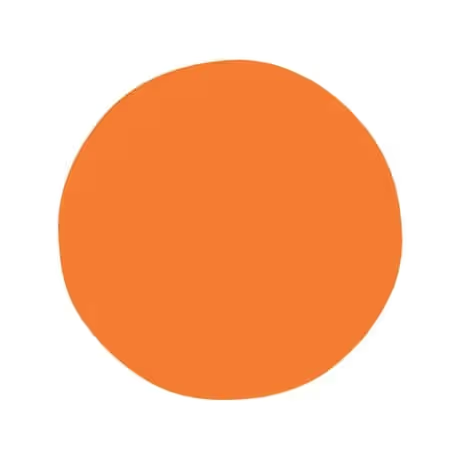
Amber
Meet Amber (#FFBF00), a brilliant golden-orange that commands attention. Its striking quality lies in its balance between the energy of yellow and the intensity of orange, offering a luminous warmth that makes any design element stand out without overwhelming the composition.
What color is Amber?
Amber is a warm, golden-orange hue that sits squarely between yellow and orange. It radiates a bright, energetic warmth without the sharp intensity of a primary yellow.
Its appearance is often marked by rich, earthy undertones, echoing the fossilized resin it is named for. This gives the color a certain depth and a spectrum of variations, from a brilliant gold to a deeper, almost brownish-orange.
What is the meaning of the color Amber (#FFBF00) in design?
Historically regarded as a protective talisman, the color Amber radiates warmth, vitality, and a sense of security. In color psychology, the shade #FFBF00 is often associated with happiness, confidence, and a spontaneous creative spirit.
This connection to sunlight and ancient resin gives Amber a timeless, organic quality. It evokes feelings of optimism and cheerfulness, yet can also carry a cautionary note, balancing approachability with assertiveness.
What are the best practices for using Amber (#FFBF00) in UI design?
In UI design, Amber works exceptionally well as an accent color. Its warmth and energy draw the eye, making it perfect for calls-to-action, notifications, or highlighting key features. For a striking effect, pair #FFBF00 with deep blues or charcoal grays to create high contrast. Alternatively, combine it with earthy tones like olive green or terracotta for a more grounded, organic palette.
While not as common as primary colors, Amber and its variants appear in prominent brands like Google Maps and Memrise, often used to guide user attention or signify important information. Its selective use in the market means that incorporating Amber can give a design a distinctive and memorable character.
Use the tools below to explore curated palettes, test color contrast for accessibility, and preview how Amber looks in real UI components from top applications.
Using Amber color codes
Using Amber in your designs often starts with its hex code, #FFBF00. This six-digit format is the standard for specifying colors on the web, making it simple to plug into CSS or design software.
Different applications, however, require different color models. For digital displays, you'll use RGB values, which define color by mixing red, green, and blue light. For physical products and print, you'll need CMYK values, which are based on ink colors. Other systems like HSL (Hue, Saturation, Lightness) offer more intuitive ways to make color adjustments.
To get you started, we’ve converted #FFBF00 into a variety of common formats. You can find and copy the exact codes you need for your project right below.
Analogous
Analogous colors are found next to Amber on the color wheel, creating a harmonious and serene palette that is pleasing to the eye.
Complementary
Complementary colors sit directly opposite each other on the color wheel. When paired with Amber, its complement creates a striking, high-contrast visual effect.
Split Complementary
A split complementary palette for Amber pairs it with the two colors adjacent to its opposite, offering a high-contrast look with less tension.
Triadic
Triadic color schemes use three hues evenly spaced on the color wheel. For Amber, this creates a vibrant, high-contrast, and balanced palette.
Tetradic
A tetradic palette for Amber involves four colors total, combining two pairs of complementary colors that form a rectangle on the color wheel.
Square
A square color scheme uses four colors evenly spaced on the color wheel. With Amber as the base, this creates a vibrant, high-contrast palette.
Text Color
Background Color
Your Catchy Large Text Goes Here
Shades
Shades of Amber result from adding black, giving the original color more depth and weight.
Tints
Tints are lighter versions of Amber, created by adding white to produce softer variations.
Tones
Tones are muted versions of Amber, created by adding gray to soften the saturation.
Hues
Hues are variations of Amber (#FFBF00), differing in intensity and temperature to create distinct moods.





Never run out of inspiration again.
Use Mobbin for free as long as you like or get full access with any of our paid plans.