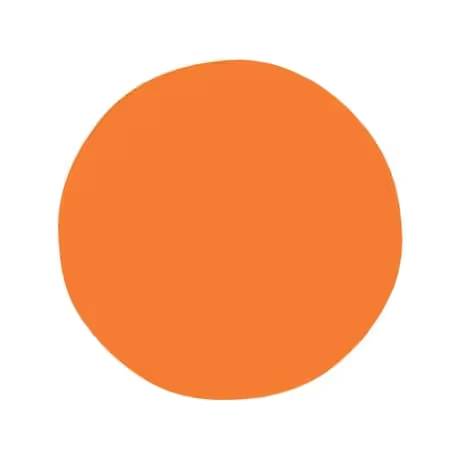
Venetian Red
Meet Venetian Red (#C80815), a deep, earthy crimson that commands attention. Its rich saturation and subtle warmth offer a sophisticated alternative to primary reds, making it a powerful choice for creating memorable visual statements in any interface.
What color is Venetian Red?
Venetian Red is a warm, earthy shade of red, reminiscent of the iron oxide pigments from which it historically originates. It presents a slightly muted and sophisticated appearance compared to a pure, bright red.
The color carries distinct brownish or terracotta undertones, giving it a rich, grounded quality. This warmth distinguishes it from cooler reds that lean towards blue or purple.
What is the meaning of Venetian Red (#C80815) in design?
Venetian Red carries the weight of history, named for the earthy pigment used by Italian Renaissance masters. This connection imbues the color with a sense of classic luxury, artistic heritage, and enduring sophistication.
Psychologically, this deep, warm red communicates passion and power, but with a grounded quality that feels more mature than aggressive. It evokes feelings of confidence, warmth, and refined drama, making it a strong choice for creating impactful statements.
How to use Venetian Red in UI design?
Venetian Red (#C80815) is a powerful accent color. Use it sparingly for primary calls-to-action, error states, or to draw attention to critical UI elements. To maintain balance, pair it with a generous amount of neutral space—think soft whites, cool grays, or deep charcoals. This contrast allows the red to stand out without creating visual fatigue. For a structured approach, consider the 60-30-10 rule, where Venetian Red serves as the 10% accent.
While not ubiquitous, this shade of assertive red appears in the branding of several major companies. You can see similar hues in the interfaces of Gmail, Tesla, and Target, often used to signify important actions or brand highlights. Its selective use by these brands shows its effectiveness in guiding user focus.
To see how Venetian Red works in practice, use the tools below. You can explore curated palettes, check color contrast ratios for accessibility, and preview #C80815 in components from well-known applications.
Using Venetian Red color codes
Working with Venetian Red in your designs starts with its hex code, #C80815, the standard for web development. Depending on your medium, however, you may need to convert this code into a different format to maintain color consistency across your projects.
For digital screens, you'll use RGB values, which define color through combinations of red, green, and blue light. If your design is intended for print, you'll need the CMYK equivalent for ink mixing. Other models like HSL (Hue, Saturation, Lightness) offer a more intuitive way to make color adjustments during the creative process.
To simplify your workflow, we've converted #C80815 into a range of popular formats. Find the code you need below and copy it directly into your tool or project.
Analogous
Analogous colors are found next to Venetian Red on the color wheel. This harmonious grouping creates a visually calm and serene palette for designs.
Complementary
Complementary colors sit directly opposite each other on the color wheel. When paired with Venetian Red, they create a striking, high-contrast visual effect.
Split Complementary
A split complementary scheme for Venetian Red uses the two colors adjacent to its direct complement, offering a vibrant yet balanced high-contrast palette.
Triadic
A triadic scheme pairs Venetian Red with two other colors, equally spaced on the color wheel, creating a vibrant and balanced high-contrast palette.
Tetradic
Tetradic palettes pair Venetian Red with three other hues, forming two complementary sets for a vibrant and visually complex combination.
Square
Using four equidistant colors on the color wheel, a square scheme offers a balanced yet highly contrasting palette built around Venetian Red.
Text Color
Background Color
Your Catchy Large Text Goes Here
Shades
Adding black to Venetian Red produces shades, which introduce a sense of depth and gravity.
Tints
Tints are created by mixing Venetian Red with white, producing softer and more airy variations.
Tones
Tones are Venetian Red mixed with gray, producing a more muted and sophisticated palette.
Hues
Hues are variations of Venetian Red, differing in intensity or temperature to create distinct moods.










Never run out of inspiration again.
Use Mobbin for free as long as you like or get full access with any of our paid plans.