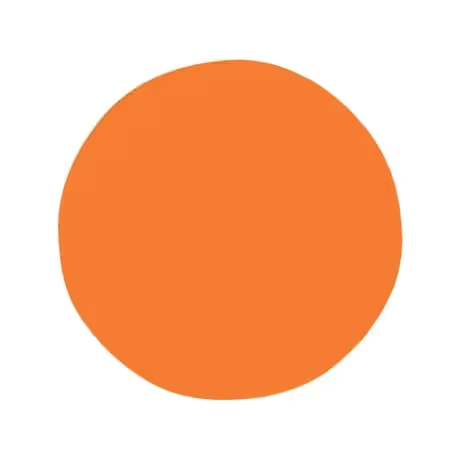
Radical Red
Radical Red (#FF355E) is a color that refuses to be ignored. This intensely saturated shade blurs the line between red and pink, creating a vibrant, almost-neon glow. It’s a high-impact hue perfect for designers looking to make a bold statement without saying a word.
What color is Radical Red?
Radical Red is a vibrant, high-saturation shade that occupies the space between red and magenta on the color wheel.
It possesses strong pinkish undertones, giving it a distinctly cool temperature that stops just short of fuchsia.
What is the symbolic meaning of Radical Red in design?
Radical Red communicates passion, excitement, and a sense of urgency. It’s a color that grabs attention and can stir strong emotions, from love and desire to confidence and power.
Symbolically, this intense shade represents courage, a departure from the ordinary, and even a touch of rebellion. It’s the color of a bold statement, often associated with forward-thinking ideas and a desire to stand out.
How should I use Radical Red in my UI design?
Radical Red, with its code #FF355E, is a powerful accent. Use it sparingly for elements like primary buttons, notifications, or active state indicators to guide user attention. For a balanced composition, apply the 60-30-10 principle, pairing it with a neutral base of deep grays or off-whites and a secondary, more subdued color. This creates a composition where the vibrancy of Radical Red stands out without causing visual fatigue.
While not a color you see everywhere, its selective use by major brands speaks volumes. Companies like Airbnb, TikTok, and Apple Music incorporate similar high-energy reddish-pinks to craft a bold, memorable identity. Choosing a color like Radical Red can signal confidence and help a product differentiate itself in a crowded market.
To see how it performs in practice, use the tools below. You can explore curated palettes, test color contrast for accessibility, and preview Radical Red in real UI components from leading applications.
Using Radical Red color codes
To use Radical Red in your projects, start with its hex code, #FF355E. Because of its high saturation, it works effectively as an accent to guide the eye or highlight key information without overwhelming a composition.
While hex codes are standard for the web, different projects require different color models. For digital screens, you'll use RGB (Red, Green, Blue), which mixes light to create color. For print materials, you'll need CMYK (Cyan, Magenta, Yellow, Key/Black), which is based on ink absorption. Other formats like HSL, LAB, and LCH provide alternative ways to define color based on attributes like hue, saturation, and lightness for precise control across media.
We have converted #FF355E into a range of popular formats for you. Find the values below, ready to copy and paste directly into your design tools.
Analogous
Built from colors adjacent to Radical Red on the color wheel, analogous schemes produce a visually pleasing and tranquil effect, ideal for unified designs.
Complementary
Complementary colors sit opposite each other on the color wheel. Pairing Radical Red with its complement creates a high-contrast, visually striking combination.
Split Complementary
A split complementary palette for Radical Red uses the two colors neighboring its direct opposite, creating a high-contrast look with more nuance and harmony.
Triadic
A triadic palette pairs Radical Red with two other colors, each an equal distance apart on the color wheel, for a bold, balanced effect.
Tetradic
A tetradic palette uses four colors arranged as two complementary pairs. See how Radical Red (#FF355E) acts as the foundation for these combinations.
Square
The square color scheme uses four colors evenly spaced on the color wheel. This arrangement gives Radical Red a vibrant, high-contrast, and energetic feel.
Text Color
Background Color
Your Catchy Large Text Goes Here
Shades
Adding black to Radical Red creates shades, which introduce a sense of depth and weight.
Tints
Tints are lighter versions of Radical Red, created by adding white for a softer feel.
Tones
Adding gray to Radical Red creates tones, which are softer, less saturated versions.
Hues
Hues are variations on Radical Red, with changes in intensity or temperature affecting the mood.












Never run out of inspiration again.
Use Mobbin for free as long as you like or get full access with any of our paid plans.