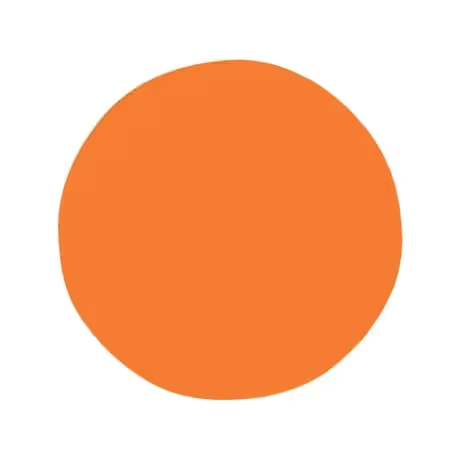
Persian Red
Meet Persian Red (#CC3333), a color that commands attention. Its striking saturation and inherent warmth make it a powerful choice for any design palette, bringing a focused energy to user interfaces without feeling overwhelming.
What color is Persian Red?
Persian Red is a warm, rich shade of red with earthy undertones, reminiscent of the clay soil of Iran. It sits between a classic crimson and a burnt orange, giving it a distinct, grounded warmth.
As the color #CC3333, it presents a bold and saturated appearance without being overly aggressive. Its composition gives it a sophisticated depth, making it a powerful yet approachable hue in a designer's palette.
What is the meaning of the color Persian Red (#CC3333)?
Persian Red, with its hex code #CC3333, is a color of intense passion and vitality. It evokes strong feelings of love, courage, and excitement, making a powerful statement in any design.
Historically, its name is tied to the rich, red ochre clay from Persia, symbolizing life, wealth, and the exquisite artistry of traditional Persian crafts like carpets and pottery.
How can I use Persian Red in my next UI design?
Persian Red (#CC3333) works brilliantly as an accent color. Use it for primary buttons, alerts, or active states to guide user attention. For a clean, modern look, pair it with a neutral palette of cool grays and crisp off-whites. This contrast allows the red to stand out without overwhelming the interface. Applying the 60-30-10 rule, where Persian Red serves as the 10% accent, can create a balanced and professional composition.
While a pure, vibrant red is a familiar sight in the branding of companies like Macy's, ExpressVPN, and Gmail, the specific depth of Persian Red is less common. Its use by brands such as Fable, HabitMinder, and Flipboard shows its potential to create a memorable identity. This relative rarity presents an opportunity for a product to distinguish itself visually in a crowded market.
To see how Persian Red performs in practice, use the tools below. You can explore curated palettes, test color contrast ratios for accessibility, and even preview #CC3333 in real UI components from some of the world's most recognized apps.
Using Persian Red color codes
When working with Persian Red, its hex code #CC3333 is your starting point for any digital project. Because of its intensity, this shade is effective for drawing attention to key elements or for use as a strong brand accent.
Your design software can instantly translate #CC3333 into other essential color models like RGB, HSL, CMYK, LAB, LCH, and XYZ. For screen-based work, you will rely on RGB values, which create color by mixing red, green, and blue light. If your design is intended for print, the CMYK code is critical, as it dictates the required mixture of cyan, magenta, yellow, and black inks.
To simplify your workflow, we have converted #CC3333 into a range of popular formats. You can find and copy the exact values you need for your project directly below.
Analogous
Sitting next to Persian Red on the color wheel, analogous colors produce a unified and tranquil palette, offering a sense of visual cohesion.
Complementary
Complementary colors sit opposite each other on the color wheel. When paired with Persian Red, they create a striking, high-contrast visual effect.
Split Complementary
The split complementary palette for Persian Red takes its direct opposite's neighbors on the color wheel, creating a striking combination with less visual tension.
Triadic
A triadic color scheme for Persian Red involves two other colors equally spaced on the color wheel, creating a vibrant, high-contrast, and balanced palette.
Tetradic
A tetradic scheme for Persian Red uses two pairs of complementary colors, forming a rectangle on the color wheel for a vibrant, balanced palette.
Square
A square color scheme pairs Persian Red with three other equidistant colors on the color wheel, creating a vibrant and balanced high-contrast palette.
Text Color
Background Color
Your Catchy Large Text Goes Here
Shades
By adding black, shades of Persian Red offer darker tones with more visual weight.
Tints
By mixing Persian Red with white, you create tints for a softer, airier feel.
Tones
Tones of Persian Red are created by adding gray, resulting in softer, desaturated variations.
Hues
Hues are variations of Persian Red that alter its intensity, creating different visual moods.












Never run out of inspiration again.
Use Mobbin for free as long as you like or get full access with any of our paid plans.