Peach
Discover Peach (#FFE5B4), a hue that balances warmth with a delicate lightness. Its striking quality lies in its ability to feel both airy and grounded, providing a soft, radiant base for interfaces without overwhelming the eye. It's a modern, foundational color.
What color is Peach?
Peach is a soft, pale color that sits in the warm spectrum, a delicate tint created from orange and yellow hues.
It carries distinct yellow and orange undertones, with variations that can appear as a subtle, creamy yellow or a more pronounced, rosy pink.
What is the meaning of the color Peach (#FFE5B4) in design?
The color Peach exudes a gentle warmth and friendliness, creating a sense of comfort and sincerity.
Symbolically, it represents approachability and care. Its soft energy is inviting and positive without being overwhelming.
How should I use Peach in my UI design?
When working with Peach in UI design, contrast is paramount. Since #FFE5B4 is a light, soft hue, it demands a darker counterpart—like a deep navy, forest green, or charcoal gray—for text and interactive elements to be legible and accessible. It performs well as a warm, inviting background or as an accent color for highlights and buttons, adding a touch of softness without overwhelming the design.
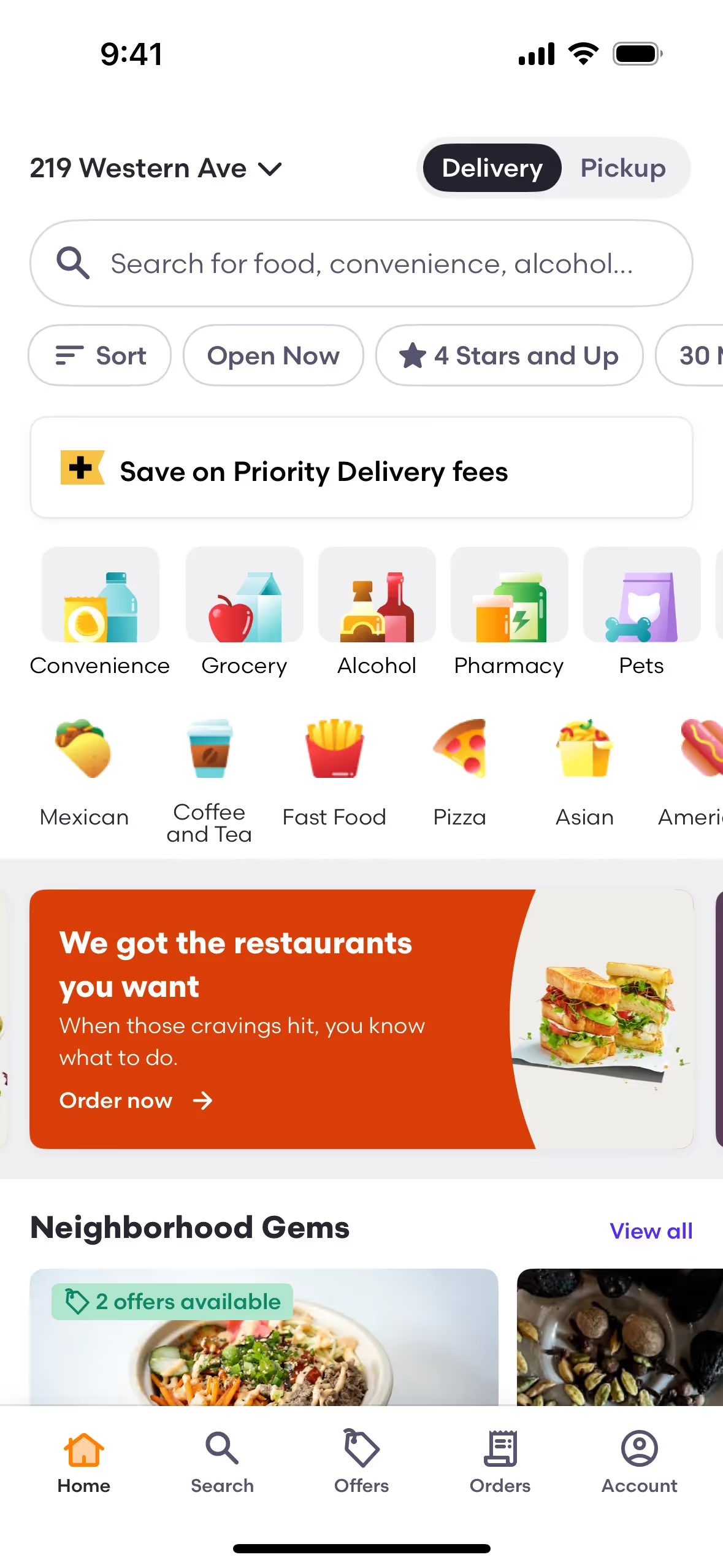
While not a common primary color for major brands, shades similar to Peach add warmth to the palettes of companies like Grubhub. Its relative rarity in branding presents an opportunity; using Peach can help a product feel distinctive and approachable, carving out a visual identity away from the more common blues and reds of the tech industry.
To see how #FFE5B4 performs in practice, use the tools below. You can explore curated palettes, test color contrast for accessibility, and preview Peach in real UI components of top brands.
How do I use Peach color codes?
Using the color Peach in your work starts with its hex code, #FFE5B4. This is the universal identifier for the color on the web, but you’ll need different codes for other applications, from digital screens to print media.
Every color model serves a specific purpose. For instance, RGB (Red, Green, Blue) values define colors for digital displays, while CMYK (Cyan, Magenta, Yellow, Key/Black) is the standard for printed materials. Other systems like HSL (Hue, Saturation, Lightness) provide a more intuitive way for designers to manipulate color attributes.
To make things easy, we’ve converted Peach (#FFE5B4) into a range of popular color code formats. You can find and copy the exact values you need for your project below.
Analogous
Analogous colors are neighbors on the color wheel. For Peach, these adjacent hues create a harmonious and tranquil palette, perfect for serene designs.
Complementary
Found on the opposite side of the color wheel, complementary colors produce a striking contrast when used alongside the soft warmth of Peach.
Split Complementary
This scheme pairs Peach with the two colors on either side of its complement, creating a high-contrast combination with less tension than a direct complementary.
Triadic
A triadic harmony is built from three colors equidistant on the color wheel. Using Peach, this combination offers a bold and balanced visual effect.
Tetradic
Tetradic schemes pair Peach (#FFE5B4) with three other colors, creating two complementary pairs for a rich and balanced four-color palette.
Square
A square color scheme pairs Peach with three other colors, all equidistant on the color wheel, resulting in a lively, balanced, high-contrast palette.
Text Color
Background Color
Your Catchy Large Text Goes Here
Shades
Adding black to Peach creates its darker shades, giving the color more depth and weight.
Tints
Tints of Peach are created by adding white, producing lighter variations with a softer feel.
Tones
Tones are created by adding gray to Peach, resulting in softer, more muted variations.
Hues
Hues are variations of Peach, differing in intensity or temperature to create distinct moods.


Never run out of inspiration again.
Use Mobbin for free as long as you like or get full access with any of our paid plans.