Blood Orange
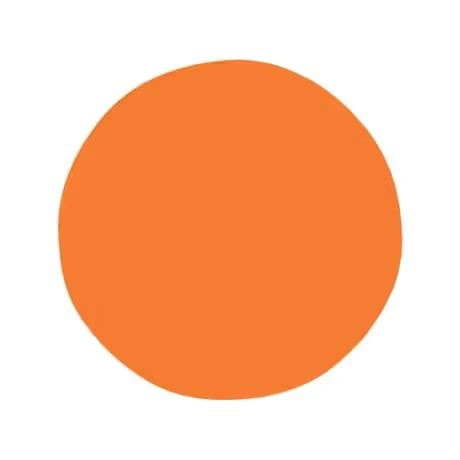
Meet Blood Orange (#D1001C), a fiery red that stops just short of pure crimson. Its intense saturation and subtle orange undertone create a uniquely vibrant hue that immediately draws the eye, making it a powerful choice for any designer's palette.
What color is Blood Orange?
Blood Orange is a deep, saturated red with a distinct orange influence, giving it a fiery and energetic character.
The color #D1001C is intensely warm, with no cool undertones, creating a vibrant and almost glowing appearance.
What is the meaning of Blood Orange (#D1001C) in design?
Blood Orange combines the energetic zest of orange with the passionate intensity of red.
It's a color of bold confidence and creative fervor, making a statement that is both sophisticated and full of life.
How do I use Blood Orange in UI design?
Blood Orange, with its intense #D1001C value, works powerfully as an accent color. Use it for critical interface elements like call-to-action buttons or notifications to command user attention. For pairings, consider setting it against deep charcoals or stark off-whites for maximum contrast. Alternatively, a split-complementary palette with shades of teal and navy can produce a vibrant, modern composition.
Brands like Uxcel, Gmail, and ESPN use similar high-energy reds to draw the eye to primary actions and key branding moments. The color is often reserved for elements that require immediate focus, making its application a deliberate choice rather than a dominant background.
Use the tools below to explore curated palettes, test color contrast for accessibility, and preview Blood Orange in real UI components from top brands.
Using Blood Orange color codes
The most direct way to use Blood Orange in a digital project is with its hex code, #D1001C. This six-digit value is the standard for web development, but it's just one of many ways to define a color.
For different media, you'll need to translate that hex value. RGB codes are for screen-based work as they define color with light, whereas CMYK values are required for anything destined for print. Other models, like HSL, provide a more intuitive way to make adjustments.
To get you started, we’ve converted Blood Orange (#D1001C) into a range of popular formats below. Simply find the code you need and copy it for your project.
Analogous
Analogous color schemes use colors adjacent on the color wheel. When built around Blood Orange, they produce a cohesive and naturally serene visual effect.
Complementary
Complementary colors are opposites on the color wheel. When paired with Blood Orange, these hues create a striking, high-contrast visual effect.
Split Complementary
A split complementary scheme for Blood Orange uses the two colors adjacent to its direct complement, offering a vibrant yet balanced high-contrast palette.
Triadic
Triadic colors form a triangle on the color wheel. With Blood Orange as a base, this combination offers a bold, multicolored effect with strong visual contrast.
Tetradic
Using Blood Orange as a base, a tetradic scheme adds three more colors, forming two complementary pairs for a bold yet harmonious combination.
Square
Based on four colors evenly spaced around the color wheel, a square scheme offers a rich, high-contrast palette built around Blood Orange.
Text Color
Background Color
Your Catchy Large Text Goes Here
Shades
Shades of Blood Orange are darker tones created by adding black for a weightier feel.
Tints
Tints of Blood Orange are created by adding white, resulting in lighter, softer hues.
Tones
Tones of Blood Orange are created by adding gray, resulting in softer, more muted versions.
Hues
Hues are variations of Blood Orange, sharing its base but with different intensities or temperatures.








Never run out of inspiration again.
Use Mobbin for free as long as you like or get full access with any of our paid plans.