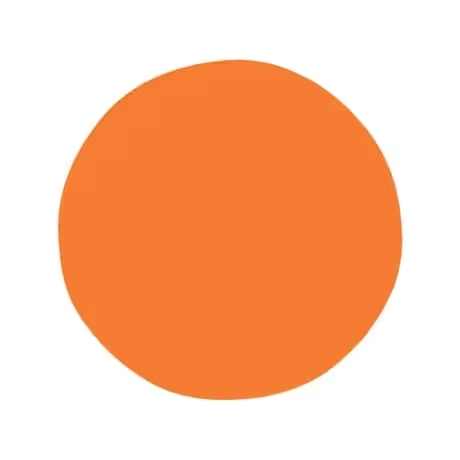
Tangerine
Meet Tangerine (#F28500), a brilliant orange that commands attention. Sitting squarely between red and yellow, its high saturation and pure hue give it an undeniable visual punch. This color doesn't just sit on the page; it brings a distinct vibrancy to any palette.
What color is Tangerine?
Tangerine is a vivid, saturated orange that captures the bright, zesty appearance of the fruit it's named after. It's a high-energy hue that leans more towards orange than red.
As a warm color, Tangerine possesses distinct yellow undertones, giving it a sunny and inviting quality. It avoids the fiery intensity of a true red-orange, settling into a more playful and approachable spot on the color spectrum.
What is the meaning of the color Tangerine in UI design?
Tangerine is a color of vibrant energy and optimism, evoking feelings of excitement, warmth, and youthful spontaneity.
It symbolically represents creativity and happiness, with a cheerful nature that can inspire adventure and determination.
How can I use Tangerine in my UI design?
To make Tangerine (#F28500) stand out in your designs, consider using it as an accent for key elements like buttons, links, or notification badges where you need to capture attention. For a balanced composition, pair it with deep navies, charcoal grays, or clean off-whites. Applying the 60-30-10 rule, with Tangerine serving as the 10% accent, can create a professional and visually striking interface.
While not a color you see every day, brands like MasterClass and Swiggy have successfully built an identity around a similar vibrant orange. Its relative rarity in the market presents an opportunity; incorporating Tangerine can help a product feel fresh and memorable, setting it apart from competitors.
Put theory into practice with the tools below. You can explore curated palettes, test your color combinations for accessibility, and preview how Tangerine appears in real UI components from leading apps.
Using Tangerine color codes
In digital design, the most direct way to specify Tangerine is with its hex code, #F28500. Its natural punchiness makes it an excellent choice for calls-to-action and other interactive elements that need to grab a user's attention.
Your project's medium will determine which color code you need. While #F28500 is standard for the web, you'll need its RGB values for most screen-based applications. If your design is headed for print, you must use its CMYK equivalent to maintain color fidelity on paper. Other formats like HSL (Hue, Saturation, Lightness) offer a more intuitive way to modify the color for different states or themes.
To get you started, we've converted Tangerine's #F28500 hex code into a range of popular formats below. Simply copy the code you need and paste it directly into your design tool or stylesheet.
Analogous
Analogous colors are neighbors on the color wheel. When paired with Tangerine, they create a harmonious and visually pleasing palette that feels calm and composed.
Complementary
To find Tangerine's complementary colors, look to the opposite side of the color wheel. These pairings produce a vibrant and energetic visual pop.
Split Complementary
A split complementary scheme for Tangerine uses the two colors adjacent to its direct complement, offering a vibrant yet balanced high-contrast palette.
Triadic
A triadic harmony is built from three colors equidistant on the color wheel. Starting with Tangerine, the result is a bold and balanced combination.
Tetradic
For Tangerine, a tetradic scheme builds a rich, four-color palette by using two pairs of complementary colors from the color wheel.
Square
Square schemes pair Tangerine with three other colors, all equidistant on the color wheel. This arrangement produces a balanced yet highly contrasting effect.
Text Color
Background Color
Your Catchy Large Text Goes Here
Shades
Shades of Tangerine are created by adding black, giving the color more depth and weight.
Tints
Tints are lighter variations of Tangerine, made by adding white to soften the hue.
Tones
Tones are muted versions of Tangerine, created by adding gray to soften its saturation.
Hues
Hues are variations of Tangerine, sharing its base color but with different intensity or temperature.


Never run out of inspiration again.
Use Mobbin for free as long as you like or get full access with any of our paid plans.