Sandy Orange
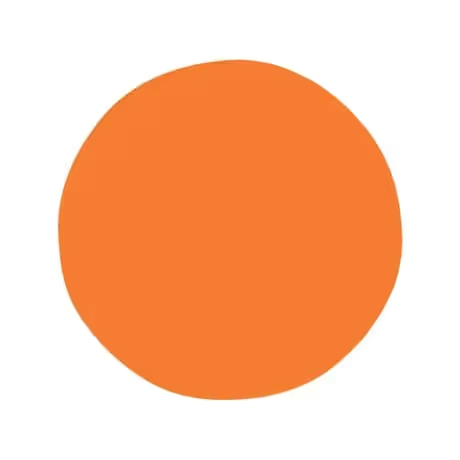
Meet Sandy Orange (#F79C4D), a luminous hue that captures attention without overwhelming the eye. Its unique character comes from a blend of bright energy and a gentle, sun-kissed quality, making it a compelling choice for modern palettes.
What color is Sandy Orange?
Sandy Orange is a warm, muted orange with a strong yellow undertone. It has a soft, earthy quality that gives it a gentle and approachable feel, distinct from more vibrant, fiery oranges.
This color sits comfortably between a golden yellow and a soft tangerine. Its appearance can shift slightly, sometimes showing hints of peach or, in shadow, a touch of earthy brown, giving it a subtle complexity.
What is the meaning of the color Sandy Orange?
Sandy Orange radiates a gentle warmth and comfort, creating an atmosphere that is both approachable and friendly. It stirs feelings of soft enthusiasm without being overbearing.
The color is a symbol of grounded creativity and cheerful optimism. It suggests an authenticity and down-to-earth quality, making it feel both innovative and genuine.
How can I effectively use Sandy Orange in my UI design?
In UI design, Sandy Orange (#F79C4D) excels as an accent color for calls-to-action and interactive elements. It creates a striking contrast when set against deep blues or charcoal grays, guiding the user's eye effectively. For a more subdued and earthy feel, pair it with analogous colors like soft yellows or complementary muted teals and greens.
While not overwhelmingly common, you can spot similar energetic oranges in the branding of companies like Swiggy and Moonly. The relative scarcity of #F79C4D in digital products means it can give a brand a distinct and memorable visual signature.
You can use the tools on this page to explore curated palettes, test color contrast for accessibility, and preview Sandy Orange in real UI components from leading brands.
How to use Sandy Orange color codes?
The hex code #F79C4D is the most direct way to specify Sandy Orange in digital projects, but designers often need to translate it for different media. Depending on your project, you might need to work with various color models beyond just hexadecimal.
Each color model serves a specific purpose. For instance, RGB values are fundamental for digital displays, mixing red, green, and blue light to create the final color on screen. In contrast, CMYK values are essential for print projects, representing the ink percentages needed. Other models like HSL, LAB, and LCH offer different ways to define and manipulate color based on properties like hue, saturation, and lightness.
To simplify your workflow, we've converted #F79C4D into a range of popular formats below. You can copy any of these codes directly for your projects.
Analogous
Analogous colors sit next to each other on the color wheel. With Sandy Orange, this combination produces a unified and tranquil visual experience.
Complementary
Complementary colors are opposites on the color wheel, creating a bold visual statement. Paired with Sandy Orange, its complement offers maximum contrast and pop.
Split Complementary
A split complementary scheme pairs Sandy Orange with the two colors adjacent to its direct complement, offering high contrast with less visual tension.
Triadic
Triadic schemes use three colors equally spaced on the color wheel. With Sandy Orange, this creates a vibrant, high-contrast, and balanced palette.
Tetradic
A tetradic palette for Sandy Orange involves four colors arranged in a rectangle on the color wheel, offering a vibrant combination of two complementary pairs.
Square
A square color scheme pairs Sandy Orange with three other colors, all spaced evenly on the color wheel for a vibrant, high-contrast effect.
Text Color
Background Color
Your Catchy Large Text Goes Here
Shades
Adding black to Sandy Orange creates shades, bringing depth and gravity to your designs.
Tints
Tints of Sandy Orange are created by mixing in white, resulting in softer, lighter hues.
Tones
Tones of Sandy Orange are made by mixing in gray, which desaturates the original hue.
Hues
Hues are variations of Sandy Orange, differing in intensity or temperature to alter a design’s mood.




Never run out of inspiration again.
Use Mobbin for free as long as you like or get full access with any of our paid plans.