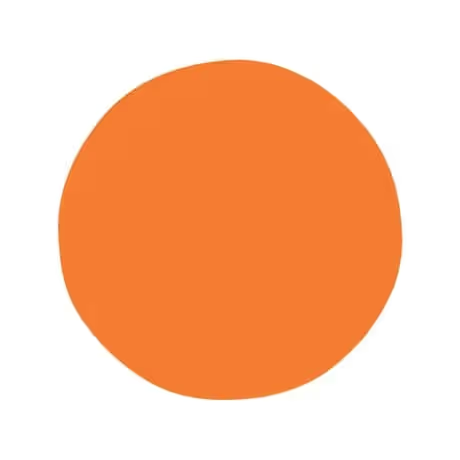
Hushed Hue
Meet Hushed Hue (#ECEDCB), a quiet off-white with a subtle yellow-green undertone. What makes this color striking is its near-neutral appearance, which provides a soft, organic warmth to a design without competing for attention. It’s a foundational shade that adds quiet complexity.
What color is Hushed Hue?
Hushed Hue is a soft, pale yellow with a subtle green undertone, giving it a creamy, off-white quality.
As a highly desaturated warm color, it reads as a gentle neutral without the coldness of a pure gray.
What is the meaning of the color Hushed Hue (#ECEDCB)?
Hushed Hue brings a quiet sense of tranquility and stillness, creating an atmosphere of gentle repose.
Symbolically, it represents a connection to the natural world and an understated elegance, perfect for thoughtful and serene compositions.
How can I use Hushed Hue in my UI design?
Hushed Hue (#ECEDCB) works beautifully as a primary background color, creating a soft, airy foundation that improves readability without causing eye strain. For contrast, pair it with deep charcoals, rich navy blues, or earthy browns for text and key interactive elements. This establishes a clear visual hierarchy. It also harmonizes well with other muted pastels and natural tones for a cohesive, organic palette.
You won't find many major brands using a color quite like Hushed Hue for their core identity. This relative rarity presents an opportunity: using it can help a product feel distinct and thoughtful, setting it apart from competitors who favor more common, high-energy palettes.
Use the tools below to explore curated palettes, test color contrast for accessibility, and preview Hushed Hue in real UI components of top brands.
How do I use the Hushed Hue color codes?
Using Hushed Hue in your digital projects is as simple as copying its hex code, #ECEDCB, directly into your CSS or design tool.
While the hex code is based on the RGB (Red, Green, Blue) model for digital screens, your project might need a different format. For print work, you'll need the CMYK (Cyan, Magenta, Yellow, Key/Black) values to ensure color accuracy on paper. Other models like HSL (Hue, Saturation, Lightness) offer a more intuitive way to make adjustments, as you can tweak each component independently.
To make things easy, we've converted Hushed Hue's #ECEDCB value into a variety of common color models. You can find and copy the exact codes you need for your project below.
Analogous
Analogous color schemes pair Hushed Hue with its neighbors on the color wheel, creating a harmonious and serene visual experience for users.
Complementary
Complementary colors sit directly opposite each other on the color wheel. Pairing Hushed Hue with its complement creates a striking, high-contrast visual effect.
Split Complementary
For Hushed Hue, a split complementary palette takes the two colors on either side of its complement, providing strong contrast with less visual tension.
Triadic
Triadic colors are three hues evenly spaced on the color wheel, creating a vibrant, high-contrast palette when built around Hushed Hue.
Tetradic
A tetradic palette combines Hushed Hue with three other colors, forming two complementary pairs for a balanced yet dynamic visual experience.
Square
A square color scheme features four colors evenly spaced on the color wheel, giving Hushed Hue a vibrant, high-contrast, and balanced palette.
Text Color
Background Color
Your Catchy Large Text Goes Here
Shades
Adding black to Hushed Hue produces darker shades, introducing depth and a sense of weight.
Tints
Tints are lighter variations of Hushed Hue, created by adding white for a softer effect.
Tones
Tones are muted versions of Hushed Hue, created by adding gray to soften its saturation.
Hues
Hues are variations of Hushed Hue, sharing its base but with different intensities and temperatures.



Never run out of inspiration again.
Use Mobbin for free as long as you like or get full access with any of our paid plans.