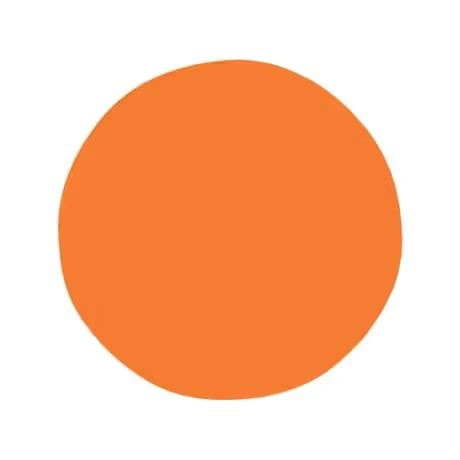
Byzantium
Meet Byzantium (#702963), a deep and saturated purple with a notable reddish undertone. This rich hue commands attention, offering a sophisticated alternative to more common purples and magentas, making it a compelling choice for distinctive design work.
What color is Byzantium?
Byzantium is a deep, reddish-purple that sits between the energy of magenta and the sobriety of a classic purple. It carries noticeable pink and red undertones, which gives the color a warm, almost velvety appearance.
It’s a sophisticated shade with a certain gravity, appearing rich yet slightly muted depending on the surrounding light and colors. This complexity keeps it from being a simple, bright violet or a straightforward red.
What is the meaning behind the color Byzantium (#702963)?
Named after the opulent Byzantine Empire, the color Byzantium carries a legacy of royalty, power, and spiritual significance. Historically, its deep purplish hue was reserved for emperors, symbolizing immense wealth and divine authority.
For designers, Byzantium (#702963) evokes a sense of sophistication and creative wisdom. The color can inspire feelings of ambition and mystery, making it a potent choice for brands aiming for a distinguished and luxurious identity.
How can I effectively use Byzantium in my UI design?
In UI design, Byzantium (#702963) works best as a potent accent color. Pair it with soft neutrals like cream, charcoal gray, or beige to make it pop without overwhelming the user. For a more adventurous palette, consider analogous blues or a contrasting mustard yellow. Applying the 60-30-10 rule, where Byzantium serves as the 10% highlight for buttons and interactive elements, can create a balanced and focused interface.
Few major brands have adopted a color similar to Byzantium, with Fetch being a notable example. This rarity presents an opportunity for distinction; using #702963 can help a product carve out a unique visual identity in a crowded market.
To see how Byzantium performs in practice, use the tools below. You can explore curated palettes, test color contrast ratios for accessibility, and preview #702963 in real UI components from top brands.
How do I use the Byzantium color codes?
Using the Byzantium color code #702963 in your projects is straightforward, but its application depends on your medium. While hex codes are standard for web development, you will need to convert #702963 into other formats for print materials or specific digital design tools.
Each color model serves a distinct purpose. RGB (Red, Green, Blue) values define colors for digital displays by adding light, whereas CMYK (Cyan, Magenta, Yellow, Key/Black) is the standard for printed media. Other models like HSL (Hue, Saturation, Lightness) or LAB offer a more intuitive way to modify color by adjusting its core attributes.
To help you get started, we have converted Byzantium's hex code #702963 into a range of popular formats. You can find and copy the exact values you need for your project below.
Analogous
Analogous color schemes use colors next to Byzantium on the color wheel. This combination creates a harmonious and visually pleasing palette, often perceived as calm.
Complementary
For a high-impact pairing, look to Byzantium's complementary color. Found directly across the color wheel, this combination offers the highest possible visual contrast.
Split Complementary
The split complementary scheme gives Byzantium a high-contrast pairing that's more versatile than a direct complement, using two adjacent hues instead.
Triadic
A triadic color scheme uses three hues evenly spaced on the color wheel. With Byzantium, this creates a vibrant, high-contrast, and balanced palette.
Tetradic
A tetradic color scheme for Byzantium uses two pairs of complementary colors, forming a rectangle on the color wheel for a rich, balanced palette.
Square
A square color scheme pairs Byzantium with three other colors, all equidistant on the color wheel, creating a vibrant and high-contrast palette.
Text Color
Background Color
Your Catchy Large Text Goes Here
Shades
Shades of Byzantium are darker versions made by adding black, giving designs depth and weight.
Tints
Tints are lighter versions of Byzantium, created by adding white to soften the hue.
Tones
Adding gray to Byzantium creates tones, offering a range of softer, less saturated options.
Hues
Hues are variations of Byzantium, sharing its base color but with different intensities or temperatures.


Never run out of inspiration again.
Use Mobbin for free as long as you like or get full access with any of our paid plans.